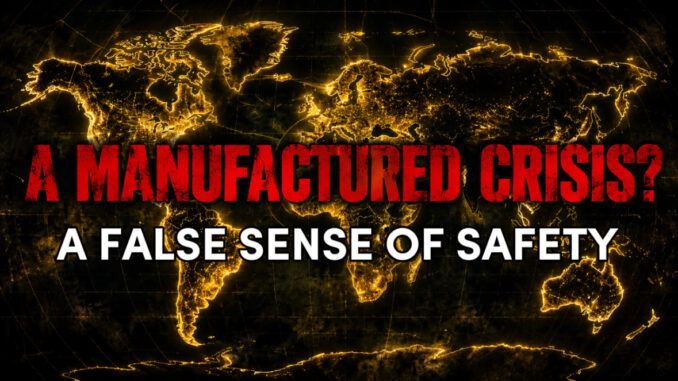
The pieces are moving. The illusion is cracking. The question is no longer what is coming, but who is paying attention.
For years, the pieces have been positioned on a global chessboard. Moves made quietly behind closed doors, strategies unfolding in the shadows, and warnings hidden in plain sight. What once appeared disconnected may now, to those questioning the direction of global events, seem increasingly interconnected.
The chessboard is no longer hidden. The pieces are moving in plain sight. And the question remains: Are you awake enough to recognise the game being played?
The Illusion of Safety: When Crisis Becomes Control
Over the coming months, we may witness an intensification of the systems and policies reshaping our world. What has been gradually introduced could become increasingly visible, raising urgent questions about personal freedom, digital surveillance and the future of individual sovereignty.
History has repeatedly demonstrated how moments of fear and uncertainty can become opportunities for extraordinary political and institutional power.
A crisis emerges. Fear spreads. The population demands protection. And suddenly, measures that would once have been fiercely resisted are presented as necessary for collective survival.
First comes the fear. Then comes the promised solution. And somewhere between the two, freedom becomes negotiable.
But what happens when the very systems promising protection become instruments of control?
What if the next major crisis, whether naturally occurring, politically exploited or deliberately manufactured, becomes the justification for restrictions far beyond anything previously accepted?
These are questions that deserve scrutiny, not unquestioning dismissal.
The Manufactured Crisis: Problem, Reaction, Solution
Consider the familiar pattern.
A crisis captures global attention. Governments and institutions respond with urgent warnings. The public is told that extraordinary circumstances require extraordinary measures.
Then come the proposed solutions.
Digital identification. Mandatory registration. Expanded surveillance. Restrictions on movement. Centralised access to essential resources. Potential rationing under the justification of emergency management.
Each measure may be presented as temporary, necessary and designed for public safety.
But when survival becomes conditional upon compliance, where does protection end and coercion begin?
Imagine a future in which access to essential services depends increasingly upon registration within centralised digital systems.
Register to participate.
Comply to gain access.
Surrender another measure of independence in exchange for the promise of security.
Those who question the arrangement risk being labelled irresponsible, dangerous or unwilling to contribute to the collective good.
It is a scenario worth examining critically, particularly as governments and corporations expand their use of digital identity and data-driven technologies.
The Price of False Security
The greatest threat to personal freedom does not always arrive through obvious force.
Sometimes, it arrives wrapped in reassuring language.
Safety. Convenience. Protection. Stability. The greater good.
Words that sound compassionate can also be used to discourage legitimate scrutiny.
And when fear becomes the dominant emotion, people may willingly accept restrictions they would otherwise reject.
The uncomfortable question is this:
How much freedom are people prepared to surrender for the promise of safety, and who decides when that freedom will be returned?
Surveillance can be normalised. Emergency powers can become permanent. Temporary restrictions can evolve into lasting structures.
Not every emergency measure is unjustified, and not every technological development is sinister. Yet history gives us sufficient reason to question concentrated power, demand transparency and insist upon meaningful accountability.
Freedom rarely disappears in a single dramatic moment. It can erode gradually, through a succession of compromises that seem insignificant until their cumulative impact becomes impossible to ignore.
Have We Already Witnessed the Rehearsal?
Cast your mind back to the not-so-distant past.
The world experienced a crisis that profoundly altered everyday life. Governments introduced unprecedented restrictions, institutions expanded emergency powers, and millions of people faced difficult decisions affecting their health, livelihoods, relationships and personal autonomy.
The COVID-19 pandemic left a lasting mark on society.
Its consequences continue to provoke debate about public health, government authority, institutional trust, individual rights and the long-term effects of emergency policies.
The COVID experience demonstrated how rapidly societies can change during a global emergency.
For some, those years reinforced the importance of collective responsibility.
For others, they raised profound questions about the boundaries of state power and the dangers of unquestioning compliance.
Both the lessons learned and the questions left unanswered deserve serious consideration.
Because remembering the past is not about remaining trapped in it. It is about recognising what must never be accepted without scrutiny again.
The Endgame: Control or Conscious Awareness?
The future of personal freedom will not be determined solely by politicians, corporations or global institutions.
It will also be shaped by the willingness of ordinary people to remain informed, question authority and defend fundamental rights.
As digital surveillance, artificial intelligence, centralised identity systems and emergency governance continue to develop, vigilance becomes increasingly important.
Who controls the infrastructure?
Who has access to the data?
Who determines the conditions of participation?
What safeguards prevent temporary powers from becoming permanent?
And perhaps most importantly, what happens to those who choose not to comply?
These are not questions reserved for conspiracy theorists. They are legitimate questions about democracy, accountability and human autonomy.
Are You Awake Yet?
The chessboard is changing.
The language of safety is becoming inseparable from conversations about control. The boundaries between convenience and dependency deserve closer examination. And the choices made today may shape the freedoms available to future generations.
Awakening is not simply about believing that hidden agendas exist. It is about developing the discernment to distinguish evidence from manipulation, truth from propaganda, and genuine protection from unnecessary control.
It means refusing to surrender your critical thinking to fear. God has not given us a spirit of fear, but of love power and a sound mind.
The most dangerous prison is the one people fail to recognise because they have been persuaded to call it safety.
So pay attention.
Question the narrative.
Examine the evidence.
Protect your independence, importantly protect your ability to be God led!
And never allow the promise of security to silence the conversation about the freedom God has given us.
The pieces are moving. The board is changing. And the next move may depend on how many people are willing to question the game.
Are you awake yet?
🔁 SHARE this powerful Christian reminder with someone who needs encouragement to pray.
🌐 Thank You for Visiting ImAChristianAndImProud.com for daily Christian encouragement, Bible teachings, spiritual warfare insights, and faith-filled inspiration.
Disclaimer: Copyright Disclaimer Under Section 107 of the Copyright Act 1976, allowance is made for “fair use” for purposes such as criticism, comment, news reporting, teaching, scholarship, and research. Fair use is a use permitted by copyright statute that might otherwise be infringing.
Image Credit: ICIP Images
Leave a Reply